The 2026 State of Breastfeeding Survey

According to Mamava's 2026 State of Breastfeeding Survey of 2,481 U.S. parents:
Online is the new first stop. 61% of parents turn to internet searches and AI tools for breastfeeding help — narrowly ahead of friends and family (60%) and lactation consultants (58%).
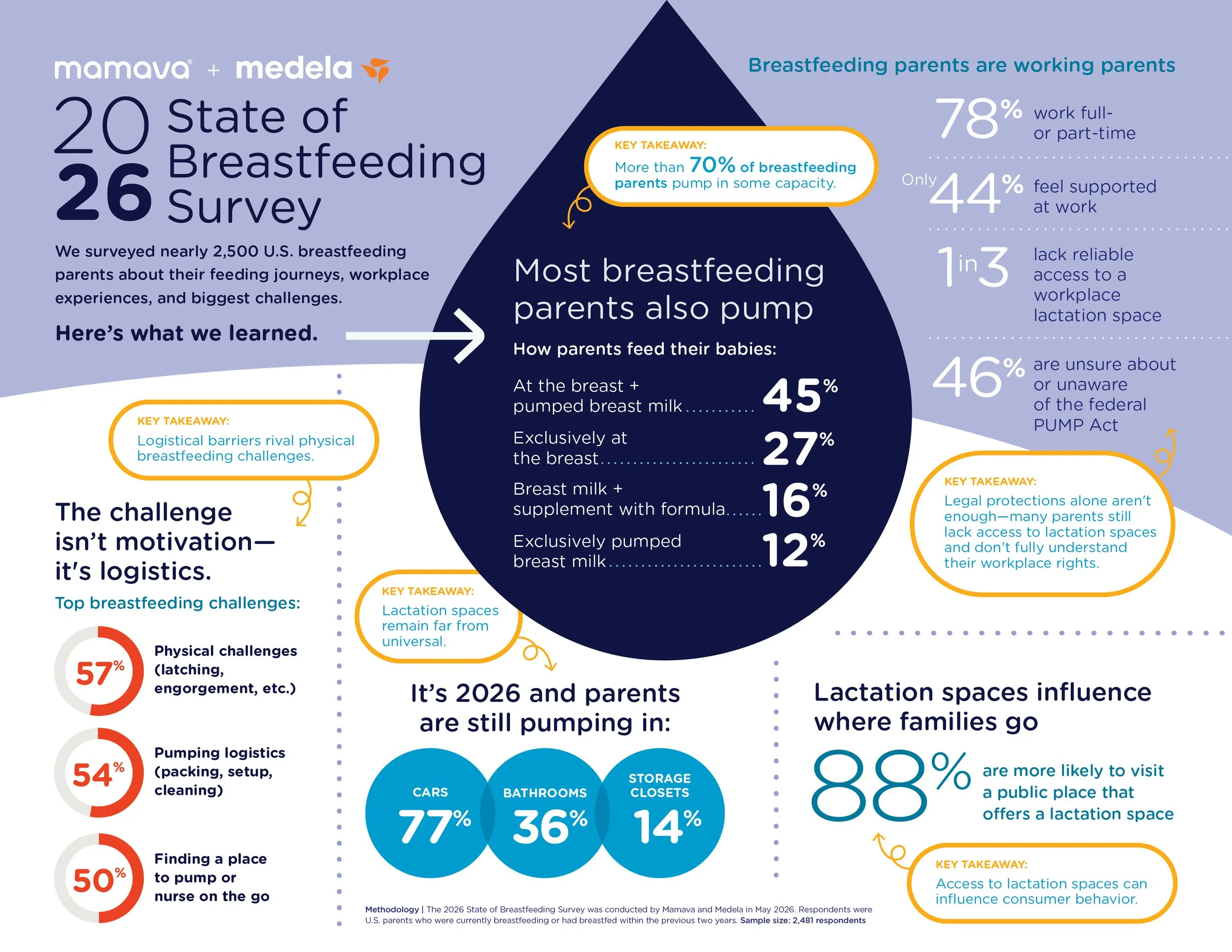
Pumping is now central to breastfeeding. More than 70% of parents pump in some capacity, and 45% both nurse and pump.
Parents are improvising for lack of space. 77% have nursed or pumped in a car, 36% in a public bathroom, and 14% in a storage closet.
Lactation access shapes where families spend. 88% of parents say they're more likely to visit a venue that offers a lactation space.
Motivation outpaces support. Despite high motivation to breastfeed, only 51% reach one year and 16% reach two.
Workplace gaps persist. Nearly one-third of working parents lack reliable access to a lactation space on the job.
Mamava and Medela surveyed nearly 2,500 breastfeeding parents to better understand their feeding journeys, support systems, and biggest challenges. The findings reveal a consistent pattern: parents are highly motivated to breastfeed, but logistical barriers continue to shape their experience at work and on the go.
Breastfeeding is often framed as a personal choice, but Mamava's 2026 State of Breastfeeding Survey suggests it's also an infrastructure issue. Access to private, functional spaces—and the time and support needed to use them—can influence whether parents are able to meet their feeding goals.
Parents are highly motivated to breastfeed, but long-term goals remain difficult to achieve
How long do most parents actually breastfeed?
Parents are highly motivated to breastfeed, citing health benefits (85%), the desire to nourish their baby (80%), and bonding (73%) as their top reasons. Yet motivation alone doesn't guarantee success. While the American Academy of Pediatrics recommends providing breast milk for up to two years (alongside complementary foods) when possible, only 16% of respondents reached that milestone, and just 51% made it to one year.
Notably, this survey was distributed by Mamava and Medela, meaning respondents likely represent a particularly engaged group of breastfeeding parents. Even among this highly motivated audience, many struggled to meet long-term feeding recommendations—suggesting that intention and commitment are only part of the equation.
Breastfeeding includes pumping for most parents
How many breastfeeding parents also pump?
For most families, breastfeeding extends beyond feeding at the breast. Pumping has become an essential part of the modern breastfeeding experience. Nearly 45% of survey respondents both nursed and pumped, while another 12% exclusively pumped. In total, more than 70% of respondents relied on pumping in some capacity. Additionally, 79% used an electric breast pump and 52% used a hands-free wearable pump.
These findings underscore an important reality for employers and public venues: supporting breastfeeding parents means supporting pumping. Access to privacy, electrical outlets, seating, and clean, dedicated spaces should be considered core infrastructure—not optional amenities.
Parents are building diverse support networks
Where do parents get breastfeeding advice in 2026?
When asked where they go for answers, internet searches and AI tools topped the list at 61%, followed closely by friends and family (60%) and lactation consultants (58%). Social media, OB/GYNs, pediatricians, and breastfeeding apps also played important roles. Rather than relying on a single source of guidance, breastfeeding parents are building support networks that blend digital tools, community advice, and professional expertise.
Logistics are the real challenge
What's the biggest barrier to breastfeeding in 2026?
When asked about their biggest breastfeeding challenges, parents identified a mix of physical and logistical barriers. While physical issues such as latching difficulties and engorgement ranked highest at 57%, pumping logistics were close behind. More than half of respondents (54%) cited the burden of packing, setting up, and cleaning pumping equipment. Nearly 50% struggled to find a place to pump or nurse when away from home, and 39% reported difficulty finding enough time during the day for pumping breaks.
Parents' optional written responses reinforced these findings, frequently describing breastfeeding as a significant mental and logistical undertaking that required constant planning, scheduling, and preparation. The findings suggest that for many families, sustaining breastfeeding is both a physical challenge and a logistical challenge.
Workplace support still has room to improve
Do employers actually support breastfeeding parents?
The majority of breastfeeding parents are also participating in the workforce. Nearly 78% of respondents reported working either full- or part-time while breastfeeding. While many parents report positive experiences, workplace support remains inconsistent. According to the survey findings, 44% agree that they feel supported at work, but more than one-quarter either feel unsupported or remain neutral about the support they receive.
Access to lactation spaces remains a challenge as well. Nearly one-third of respondents report lacking reliable access to a workplace lactation space, either because one is unavailable or only accessible some of the time.
Awareness of legal workplace protections also remains uneven. Although the federal PUMP Act has been in effect for several years now, 46% of respondents say they either don't understand the law's requirements or aren't aware of it at all.
Public spaces have work to do
Where do breastfeeding parents pump when they're away from home?
The survey also highlights persistent gaps in lactation support outside the workplace. More than three-quarters of respondents (77%) have pumped or nursed in a car, while 36% have used a bathroom and 14% have used a storage closet. These findings suggest that many parents continue to rely on improvised spaces when lactation accommodations are unavailable.
At the same time, parents clearly value lactation-friendly environments. Only 21% of respondents describe public spaces as inclusive and supportive of breastfeeding families, while 88% say they are more likely to visit a venue if they know a lactation space is available.
For airports, museums, stadiums, zoos, shopping centers, and other public destinations, the message is clear: lactation spaces help families feel welcome and can influence where parents choose to spend their time.
Together, these findings suggest that compliance alone is not enough. Employers have an opportunity to strengthen support for breastfeeding employees by improving awareness, increasing visibility of available resources, and ensuring reliable access to workplace lactation spaces.
The bottom line
Parents are highly motivated to breastfeed, but the biggest barriers are logistical: finding time, finding space, and managing the realities of pumping in environments that weren't designed with breastfeeding families in mind.
As employers and public venues invest in family-friendly experiences, dedicated lactation infrastructure remains one of the most practical and impactful ways to support breastfeeding parents.
Year-Over-Year Trends: What's Changed Since 2025?
When we compare these results to our 2025 State of Breastfeeding Survey, a few striking trends emerge about the evolving landscape of lactation support:
Parents are increasingly turning to the internet and AI: In 2025, lactation consultants were the number one source of information. In 2026, the internet and AI tools have taken the top spot (61%), edging out professionals and family members.
The venue ROI is strong: The business case for public lactation spaces continues to grow. Last year, roughly 86% of parents said they were more likely to visit a public place if it offered a space; in 2026, that number rose to 88%.
Workplace support has stalled: Despite increased awareness, the gaps in workplace infrastructure have not materially improved. In both 2025 and 2026, roughly one-third of working parents reported lacking reliable access to a workplace lactation space, and nearly half continue to be unaware of or confused by the federal PUMP Act.
Survey methodology: The 2026 State of Breastfeeding Survey was fielded by Mamava and Medela over three weeks in May of 2026. Respondents were U.S. parents who are currently nursing or have breastfed within the last two years, totaling 2,481 responses.
For media inquiries contact: [email protected]
Mamava designs privacy and wellness pods—including freestanding lactation pods—to support parents and people seeking focus, care, and calm in workplaces and public spaces.


More resources